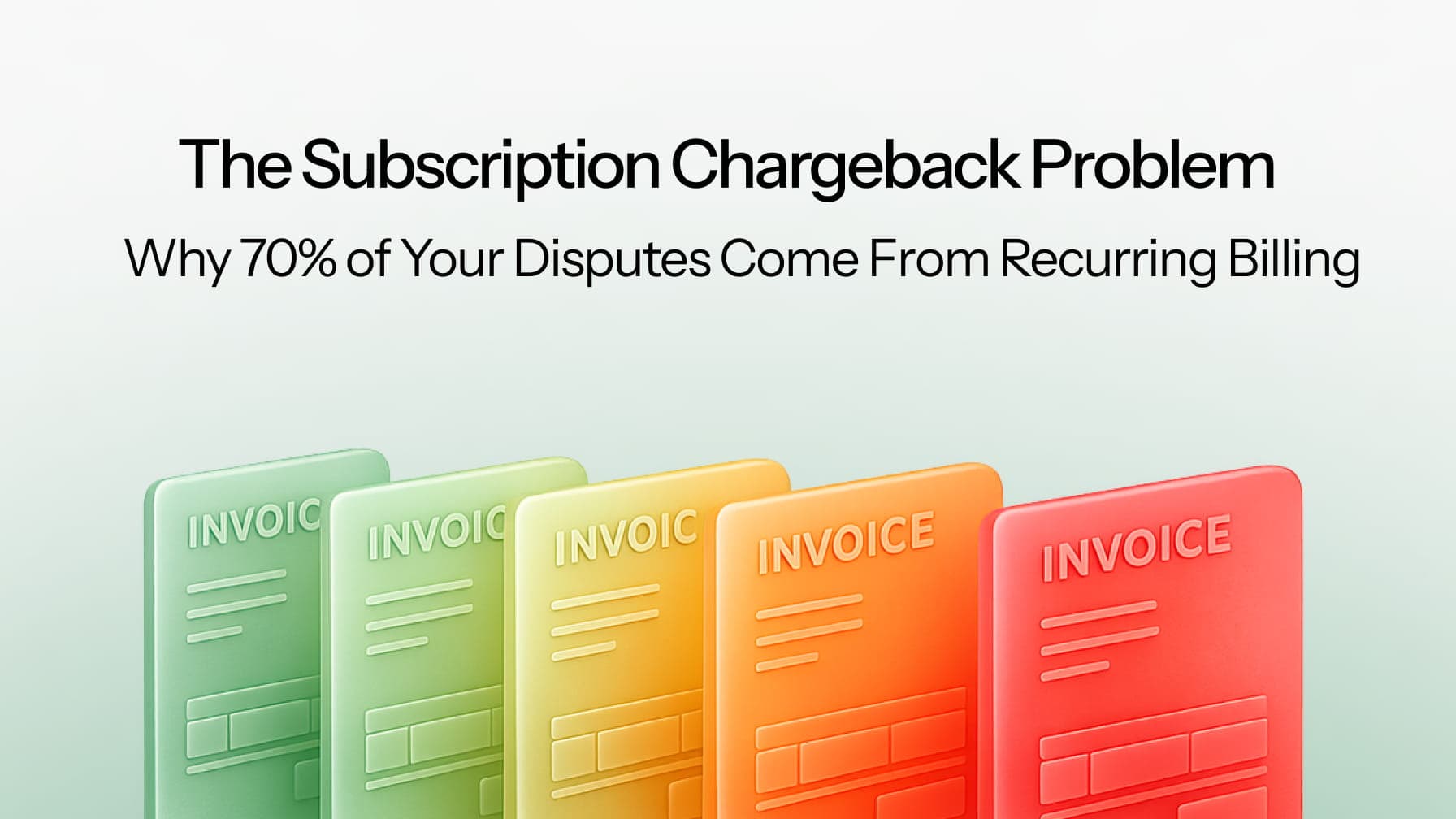
The Subscription Chargeback Problem: Why 70% of Your Disputes Come From Recurring Billing
A customer signs up for your 7-day free trial. They test your product and love it. Then 30 days later they file a chargeback. This isn't an isolated incident — subscription businesses face chargeback rates of 1-2%, nearly double traditional eCommerce.
A customer signs up for your 7-day free trial. They test your product and love it. Everything works perfectly.
Then 30 days later they file a chargeback.
They claim they never authorized the charge. Or they "forgot" they signed up. Or your billing descriptor confused them. Regardless of the reason, you just lost $400 on a $29 subscription.
This isn't an isolated incident. It's happening across the entire subscription economy. And it's getting worse.
The numbers tell the story
Subscription businesses face a unique chargeback problem that traditional eCommerce merchants don't deal with.
| Metric | Subscription | Standard eCommerce |
|---|---|---|
| Average chargeback rate | 1-2% | 0.5-0.7% |
| Risk from free trials | 9.7% of merchants | Not applicable |
| Recurring billing disputes | 27.1% of chargebacks | Not applicable |
| Friendly fraud percentage | 70-79% | 40-60% |
Subscription businesses face chargeback rates between 1% and 2%. That's nearly double what traditional eCommerce sees.
The problem centers on one specific moment. The first billing cycle after a free trial ends.
The first billing crisis
Here's what happens when free trials convert to paid subscriptions.
A customer enters their credit card for a "$0 trial." The trial ends. Your system automatically charges them for the first full month. The customer sees an "unexpected" charge on their statement.
They have two options. Contact your support team and request a refund. Or call their bank and file a chargeback.
Research shows 76% of consumers prefer to resolve disputes through their bank rather than contacting the merchant directly. They find it faster and easier.
When that first charge hits, disputes spike. Subscription companies report seeing the highest chargeback volume immediately following billing cycles. The first charge after a free trial is especially vulnerable.
Why? Three reasons drive most first-billing disputes:
Forgetfulness: The trial lasted 7, 14, or 30 days. Customers genuinely forgot they signed up. When they see the charge, they assume it's fraud.
Billing descriptor confusion: Your trial signup showed "YourCompany Inc." But the charge appears as "YCI Payment Processing" or your legal entity name. The customer doesn't recognize it.
Price shock: The trial was $0 or $1. The first full charge is $29, $49, or $99. Customers who didn't read the terms feel surprised by the price jump.
Each of these scenarios looks identical to your payment processor. A customer disputes a legitimate charge. You lose the revenue. You pay the fees. Your VAMP ratio takes the hit.
As we covered in our VAMP guide, every dispute counts against your monitoring threshold whether it's fraud or friendly fraud.
Why subscription chargebacks cost more than you think
Take that $29 subscription chargeback. Most business owners see it as a $29 problem.
They're missing the full picture. As detailed in our analysis of the true cost of chargebacks, each dispute triggers a cascade of costs:
| Cost Component | Amount |
|---|---|
| Refund to customer | $29.00 |
| Chargeback fee | $15.00 |
| Alert fee (if flagged) | $40.00 |
| Staff time (4 hours at $50/hr) | $200.00 |
| Lost service delivery | $5.00 |
| Total loss per $29 charge | $289.00 |
You're out $289 on a $29 subscription charge.
But subscription businesses face an additional hidden cost that one-time purchase merchants don't. Lifetime value destruction.
That customer who filed the chargeback would have stayed subscribed for an average of 8 months. At $29 per month, that's $232 in lost future revenue on top of the immediate $289 loss.
Total impact: $521 in losses from a single $29 chargeback.
Now multiply that by dozens of disputes per month. The math becomes painful fast.
The VAMP pressure on subscription businesses
Subscription merchants face unique pressure under Visa's VAMP monitoring program.
As detailed in our complete VAMP threshold guide, VAMP combines both fraud reports (TC40) and disputes (TC15) into a single ratio:
VAMP Ratio = (Fraud Alerts + Disputes) / Settled Transactions
For subscription businesses already running at 1-2% chargeback rates, this creates immediate compliance pressure. Here's how different VAMP thresholds affect a business with 5,000 monthly subscribers:
| VAMP Threshold | Max Allowed Disputes | What Happens |
|---|---|---|
| 2.2% (Current Excessive) | 110 disputes | Monthly monitoring begins |
| 1.5% | 75 disputes | Stricter monitoring starts |
| 1.0% | 50 disputes | Payment gateway flags account |
| 0.9% (Apr 2026 Excessive) | 45 disputes | VAMP fines begin ($10/dispute) |
| 0.75% (VDMP Threshold) | 37 disputes | $50/dispute fines after month 4 |
| 0.5% (Acquirer Pressure) | 25 disputes | Reserve requirements, termination risk |
The April 2026 threshold changes make compliance significantly harder. A subscription merchant with 5,000 monthly billings can only afford 45 combined fraud alerts and disputes before crossing into "excessive" territory.
For subscription businesses, this threshold is dangerously easy to hit. Free trial abuse alone can generate enough fraud alerts to push you over the line. Add in friendly fraud from forgotten renewals and billing descriptor confusion, and you're suddenly facing monitoring programs, reserve requirements, or account termination.
The timeline matters too. VAMP evaluates monthly. One bad month can trigger enforcement actions that take months to resolve.
The five subscription chargeback triggers
Subscription disputes come from five specific friction points in the customer journey.
1. The forgotten trial conversion
The problem: Customers sign up for free trials and forget to cancel before billing starts.
This accounts for approximately 9.7% of all merchant chargeback risk according to industry surveys. For subscription-only businesses, that percentage runs much higher.
The customer psychology is simple. They saw "free trial" and entered their card to test your product. They didn't register that automatic billing would begin. When the charge appears, they dispute it as unauthorized.
What triggers the chargeback:
- Trial periods longer than 7 days (customers forget)
- No reminder emails before billing starts
- Silent conversion from trial to paid
- No clear cancelation confirmation
2. The billing descriptor mismatch
The problem: The name on the customer's credit card statement doesn't match your brand name.
This single issue causes approximately 25% of "unrecognized transaction" chargebacks across all industries. For subscription businesses, the impact is amplified because customers see these charges every month.
Here's what happens. Customer signs up at "FitPro Wellness." The charge appears as "FITPRO HOLDINGS LLC" or "FPW*SUBSCRIPTION."
The customer spent 30 seconds signing up a month ago. They don't remember the exact company name. The billing descriptor doesn't match. They assume the charge is fraudulent and dispute it.
What makes it worse:
- Parent company names instead of brand names
- Abbreviations customers don't recognize
- Payment processor prefixes (PP*, SQ*, etc.)
- Legal entity names vs. trading names
3. The price jump surprise
The problem: Trial pricing doesn't match regular pricing, and customers weren't paying attention.
Common pattern: $1 for 14 days, then $49.99 monthly. The customer sees "$1 trial" and stops reading. When $49.99 hits their account, they experience sticker shock.
Even if the pricing was clearly disclosed during signup, customers often miss it or forget. By the time billing occurs, the price feels unfair or unexpected.
Risk factors:
- Large price differences between trial and regular pricing
- Buried pricing disclosure in terms and conditions
- No email reminder mentioning the upcoming charge amount
- No warning about the price change
4. The impossible cancellation
The problem: Customers can't figure out how to cancel before they're charged.
While the federal FTC Click-to-Cancel rule was vacated in July 2025, similar requirements remain enforceable through ROSCA, state laws (California, New York, Colorado, Delaware, DC), and card network policies.
The principle remains the same. If signup was online, cancellation must be available online. If cancellation requires calling customer service, waiting on hold, and navigating retention offers, customers skip straight to filing chargebacks.
From the customer's perspective, a chargeback is their cancellation method when the real cancellation process feels too difficult.
Common cancellation failures:
- No visible cancellation option in account settings
- Requiring phone calls during business hours only
- Retention offers that delay or obscure the actual cancel button
- Confirmation emails that never arrive
- Subscription continuing after "successful" cancellation
5. The annual renewal shock
The problem: Annual subscriptions renew automatically after 12 months, and customers forgot about them.
This hits harder than monthly renewals. A $10/month subscription feels manageable. A $120 annual charge appearing unexpectedly triggers immediate dispute behavior.
The psychology is different too. Monthly charges become part of the customer's regular expenses. Annual charges feel like new purchases. When that $120 hits after 12 months, customers often don't remember the original signup at all.
What drives disputes:
- No reminder before annual renewal
- No option to switch to monthly billing
- Full year charged upfront instead of monthly
- Price increases from previous year
- Customer circumstances changed during the year
The regulatory landscape changed
Understanding the current compliance requirements matters for chargeback prevention.
The FTC finalized a "Click-to-Cancel" rule in October 2024 that would have required subscription businesses to make cancellation as easy as signup. The rule was scheduled to take full effect on July 14, 2025.
However, the U.S. Court of Appeals for the Eighth Circuit vacated the rule on July 8, 2025. The court found the FTC failed to follow proper rulemaking procedures.
This doesn't mean subscription businesses can ignore cancellation requirements.
The same obligations are still being actively enforced through multiple channels:
ROSCA (Restore Online Shoppers' Confidence Act): Federal law requiring clear disclosure of terms, express informed consent, and simple cancellation mechanisms.
State auto-renewal laws: California (updated July 2025), New York, Colorado, Delaware, and DC all require online cancellation when signup occurred online. More states are adding similar requirements.
Card network requirements: Visa and Mastercard mandate transparent billing, clear disclosures, cancellation confirmations, and reasonable cancellation processes. Failure to comply increases chargeback risk and can trigger account reviews.
FTC Section 5 enforcement: The FTC continues aggressive enforcement against "deceptive" subscription practices. Recent settlements with Amazon ($2.5 billion), Match.com, Chegg, and Cleo AI establish the current compliance standards.
The bottom line for subscription merchants: Regardless of the federal rule's status, you need transparent pricing, clear disclosures, express consent, and simple cancellation processes. Both to prevent chargebacks and to avoid regulatory enforcement.
Prevention strategies that work
Subscription chargebacks are preventable. The key is catching risk before it becomes a dispute.
Strategy 1: Redesign the trial-to-paid transition
The first billing cycle after a trial is your highest-risk moment. Make this transition as clear and friction-free as possible.
Pre-billing email sequence:
- Day -3: "Your trial ends in 3 days. Here's what happens next."
- Day -1: "Your trial ends tomorrow. You'll be charged $XX on [date]."
- Day 0: "Your trial has ended. Thank you for subscribing! Your first charge of $XX has been processed."
Include these elements in each email:
- Exact charge amount
- Billing date
- Your company name (matching billing descriptor)
- Direct link to cancel
- Customer service contact info
This isn't about asking permission to charge them. They already agreed. It's about eliminating surprise.
Trial conversion page: At the end of the trial period, show a confirmation screen before charging. List:
- What they're subscribing to
- Monthly or annual price
- Next billing date
- How to cancel
- Your billing descriptor
One extra confirmation screen prevents dozens of chargebacks.
Strategy 2: Fix your billing descriptor
Your billing descriptor should match your brand name exactly. This single change can reduce "unrecognized transaction" chargebacks by 25%.
Current descriptor: FITPRO HOLDINGS LLC
Better descriptor: FITPRO WELLNESS
Best descriptor: FITPRO WELLNESS 555-0123
Include your customer service phone number when possible. When customers see an unfamiliar charge, they call you instead of their bank.
Check how your descriptor appears on statements for all major card networks. Test with Visa, Mastercard, Amex, and Discover. They sometimes truncate or format differently.
Descriptor requirements:
- Maximum 25 characters (including spaces)
- Use recognizable brand name
- Avoid abbreviations customers won't understand
- No special characters that get stripped out
- Include contact phone number if space allows
Work with your payment processor to test your descriptor display before you go live.
Strategy 3: Make pricing unmissable during signup
Customers miss pricing details buried in terms and conditions. Make pricing part of the primary signup flow.
Show pricing three times:
- On the signup page: Large, clear text showing trial price and regular price
- During checkout: Final confirmation before payment with exact amounts and dates
- In welcome email: Immediate confirmation with pricing breakdown
Use this format:
"Your 14-day trial: $1
After trial: $49.99/month starting February 19, 2026
Cancel anytime before February 19 to avoid charges"
Make the post-trial price equally prominent as the trial price. Don't hide it in fine print.
Strategy 4: Implement true one-click cancellation
Cancellation difficulty directly correlates with chargeback rates. The harder you make it to cancel, the more disputes you'll see.
Minimum requirements:
- Cancellation option visible in account settings
- No phone calls required if signup was online
- No retention offers before the cancel button
- Confirmation email sent immediately
- Cancellation takes effect immediately or at period end (customer's choice)
What "one-click" actually means:
- Customer logs in
- Clicks "Manage Subscription" or "Cancel"
- Confirms cancellation
- Receives confirmation email
That's it. No surveys. No "Are you sure?" screens. No "Let me transfer you to retention." Just a simple cancellation that works.
California, New York, Colorado, Delaware, and DC legally require this if signup was online. Card networks require it to avoid dispute rate increases. And most importantly, customers expect it.
Strategy 5: Send renewal reminders for annual subscriptions
Annual renewals need special handling. Twelve months is long enough that customers forget about the subscription entirely.
Annual renewal email sequence:
- 30 days before renewal: "Your subscription renews in 30 days"
- 7 days before renewal: "Your subscription renews in 7 days. Here's what to expect."
- Day of renewal: "Your subscription has renewed. Thank you for continuing!"
Each email should include:
- Exact renewal date
- Exact charge amount
- Any price changes from last year
- Link to cancel
- Link to update payment method
- Your contact information
Some customers want to continue but need to update their credit card first. Give them enough notice to do that before the charge fails and creates friction.
How to identify at-risk subscriptions before they become chargebacks
Prevention beats reaction. The question is how to identify which subscriptions are likely to result in disputes.
This is where predictive analysis changes everything.
Traditional chargeback management waits for disputes to happen, then fights them. That's too late. By the time the chargeback is filed, you've already lost the fee and taken the VAMP ratio hit.
Prevention requires identifying risk signals early.
Look for patterns that predict future disputes:
Risk Signal 1: Trial conversions with no product usage — Customer signed up, entered payment info, never logged in again. When trial converts to paid, high dispute risk.
Risk Signal 2: Failed payment attempts before first charge — Card declined during trial. Customer updated payment method. New card information with different name or address. Elevated fraud risk.
Risk Signal 3: High-risk email patterns — Temporary email services. Email domains associated with past chargebacks. Multiple signups from same email with slight variations.
Risk Signal 4: Geographic mismatches — IP address in one country. Billing address in different country. Card issued in third country. Strong fraud indicator.
Risk Signal 5: Signup behavior patterns — Signup completed in under 30 seconds. No time spent reviewing pricing or terms. Multiple trial signups from same device or IP.
Each of these signals individually might mean nothing. Combined, they predict chargeback risk with high accuracy.
This is why Presolve scores every transaction from 1 to 5.
Upload your subscription transaction data. Get risk scores back for each active subscription. See exactly which customers are likely to file disputes before they do.
When you spot a high-risk subscription, you can act:
For scores of 4-5 (highest risk):
- Proactive outreach before next billing cycle
- Verify customer actually wants the subscription
- Offer to cancel if they're not using it
- Document the conversation
For scores of 3 (moderate risk):
- Extra clear pre-billing reminder emails
- Customer service follow-up if payment fails
- Monitor for usage patterns
For scores of 1-2 (low risk):
- Standard renewal process
- Normal customer communication
The goal isn't to cancel legitimate subscriptions. It's to identify customers who don't remember signing up or aren't using your product before they file chargebacks.
Real cost comparison: Prevention vs. Fighting
Let's run the numbers on prevention versus fighting chargebacks after they happen.
Scenario: Subscription business with 5,000 active subscribers at $29/month
| Approach | Reactive (Fighting Chargebacks) | Proactive (Prevention) |
|---|---|---|
| Monthly chargeback rate | 1.5% (75 disputes) | 0.3% (15 disputes) |
| Cost per chargeback | $289 | $289 |
| Monthly chargeback losses | $21,675 | $4,335 |
| Staff time (hours/month) | 300 hours | 60 hours |
| Staff cost | $15,000 | $3,000 |
| Monthly total cost | $36,675 | $7,335 |
| Annual cost | $440,100 | $88,020 |
The reactive approach costs $440,100 annually. The proactive approach costs $88,020 annually.
Savings from prevention: $352,080 per year.
That doesn't include avoiding VAMP monitoring programs, reserve requirements, or potential account termination.
But those become real risks when your chargeback rate sits at 1.5%. At that level, you're approaching the thresholds that trigger enforcement actions starting April 2026.
Prevention keeps you under the threshold. Fighting chargebacks after they're filed doesn't.
The lifetime value equation
Subscription businesses have a unique advantage over one-time purchase merchants. Customer lifetime value.
When you prevent a chargeback on a subscription customer, you're not just saving $289 on a $29 charge. You're protecting months of future revenue.
Average subscription customer lifetime value calculation:
| Metric | Value |
|---|---|
| Monthly subscription price | $29 |
| Average customer lifetime | 8 months |
| Lifetime value | $232 |
| Plus saved chargeback costs | $289 |
| Total value protected per prevented chargeback | $521 |
Prevent 60 chargebacks per month. You protect $31,260 in lifetime value.
That's revenue that continues flowing instead of being interrupted by disputes, cancellations, and negative customer experiences.
The math changes the prevention versus fighting equation dramatically for subscription businesses.
What to do right now
If you run a subscription business, these actions will reduce your chargeback rate immediately:
Week 1: Fix your billing descriptor
- Contact your payment processor
- Change descriptor to match your brand name
- Test on actual credit card statements
- Add customer service phone number if possible
Week 1: Implement trial reminder emails
- Set up automated email sequence
- Send reminders at Day -3, Day -1, and Day 0
- Include exact charge amount and billing date
- Provide clear cancellation link
Week 2: Audit your cancellation process
- Attempt to cancel a test subscription yourself
- Time how long it takes
- Count how many clicks or pages required
- Fix any friction points immediately
Week 2: Review annual renewal communications
- Set up 30-day and 7-day renewal reminders
- Include charge amount and renewal date
- Provide cancellation link
- Send confirmation on renewal day
Week 3: Analyze your current chargeback data
- Pull last 90 days of disputes
- Identify patterns (first billing? Annual renewal? Descriptor confusion?)
- Calculate your current VAMP ratio
- Determine your distance from threshold limits
Week 4: Implement risk scoring
- Upload transaction data to identify at-risk subscriptions
- Score active subscriptions for chargeback risk
- Create outreach plan for high-risk customers
- Monitor results monthly
These changes don't require engineering resources or months of development time. Most can be implemented in days.
The results appear quickly. Merchants who implement clear billing descriptors, trial reminders, and one-click cancellation typically see chargeback rates drop 35% within 60 days.
The prevention advantage
Subscription businesses face higher chargeback risk than traditional eCommerce. Recurring billing, free trials, and automatic renewals create natural friction points where disputes occur.
But subscription businesses also have a prevention advantage. You know exactly when high-risk moments occur. Trial conversions. First billings. Annual renewals. These are predictable.
That predictability makes prevention possible.
You can't prevent chargebacks on surprise one-time purchases. But you can prevent subscription disputes by addressing known risk factors before billing occurs.
The businesses that win in the subscription economy are the ones that stop chargebacks before they happen. They fix billing descriptors. They send clear reminders. They make cancellation simple. They identify at-risk customers before those customers call their banks.
They keep their VAMP ratios under control. They avoid monitoring programs and reserve requirements. They protect customer lifetime value instead of watching it disappear through disputes.
Stop subscription chargebacks before they cost you everything.
Presolve identifies at-risk subscriptions before disputes happen. Upload your transaction data, get risk scores, and take action before customers file chargebacks. Learn more at presolve.co.
Stop Disputes Before They Happen
Presolve's AI predicts which transactions will become chargebacks before the customer calls their bank. Prevent disputes automatically while you sleep.
Learn MoreData Sources:
- Visa Acquirer Monitoring Program (VAMP) Guidelines (2025-2026)
- LexisNexis Risk Solutions, "True Cost of Fraud Study 2025"
- Merchant Risk Council, Industry Research (2024-2025)
- FTC Click-to-Cancel Rule (October 2024, vacated July 2025)
- ROSCA (Restore Online Shoppers' Confidence Act)
- State auto-renewal laws: California, New York, Colorado, Delaware, DC
Every chargeback costs you $400+. Prevention costs a fraction of that.
Stop fighting chargebacks after they happen. Presolve identifies high-risk transactions before disputes are filed, saving you time, money, and your merchant account.